
 Strategies for Make-to-Order (MTO) Production
Purpose
The planning strategies explained in this section are designed for the production of a material for a specific individual sales order. In other words, you do not want to produce finished products until you receive a sales order. This means that make-to-order strategies always support a very close customer-vendor relationship, because your sales orders are closely linked to production.
The same relationship exists between the sales order and production that exists in a make-to-order environment. Make-to-order is also used in the following environments.
- Production using variant configuration
- Assemble-to-order
Prerequisites
Choose a make-to-order strategy, if:
- The materials are segregated. In other words, they are uniquely assigned to specific sales orders.
- Costs must be tracked at sales order level and not on material level.

Make-to-order strategies should always be combined with lot-size key EX (lot-for-lot. Rounding values should not be used. If you maintain rounding values, they have no effect due to the make-to-order properties of these strategies.
Process Flow
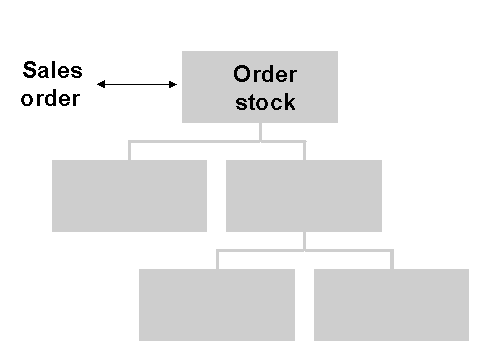
- There are extensive options that enable you to procure components especially for specific sales order items.
You may, however, want to use a different planning strategy to procure components without sales orders. This allows you to keep your replenishment lead time to a minimum. You can do this by:
- Planning on the basis of the finished product (see Planning Without Final Assembly (50) or Planning with a Planning Material (60))
- Planning at component level (see Strategies for Planning Components)
- Using consumption-based or Kanban-controlled components
- Customer stock can exist on any BOM level. See Stockkeeping at Different BOM Levels for more information.
- Because production is closely linked to sales orders, this results in a customer section in the stock/requirements list.
- Unplanned goods receipts (such as returns) cannot, as a rule, be used for other sales orders, even if they are in working order, unless they are adapted to meet a customer's needs.
In the basic make-to-order strategy, Make-to-Order Production (20), no specific product structures are required. This means that it does not matter if the material has a BOM or not. The material can be produced in-house, or it can be procured externally. No planning is involved in this strategy.
Planning Without Final Assembly (50) and Planning with a Planning Material (60) do require a specific product structure (i.e. a BOM, which means materials are always produced in-house). These planning strategies assume that you want to plan procurement (production or purchasing) of your components by planning the finished products. This means that you need to have a fairly stable demand for your finished products. If, however, you can plan more easily at component level than at finished product level, see Strategies for Planning Components.