
 Strategies for Planning Components
Purpose
The planning strategies explained in this section are designed for planning the procurement (production or purchasing) of components by planning the components themselves. This is particularly useful in the following cases:
- There is a variety of finished products (possibly with an irregular demand pattern where planning is not possible).
- The finished products are consumption-based.
The overall purpose of planning at component level is to procure components to stock (without sales orders) in order to react to customer demand as quickly as possible.
Prerequisites
Choose a strategy for planning components, if:
- The components are not segregated; that is, they are not uniquely linked at specific orders.
- Costs should be tracked at component (material) level and not at order level.
Process Flow
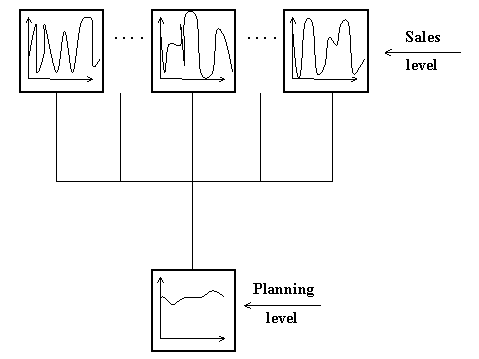
Strategies for planning components can be used for both make-to-stock and make-to-order scenarios.

If you want to make use of a strategy for a make-to-stock planning of components in a make-to-order environment, you may want to consider setting the Individual/coll. indicator (on the MRP screen) to 2 as a starting point for your master data setup.
The planning of components has the following in common with make-to-stock strategies:
- It is possible to automate the planning stage by using information from the forecast, and passing on the results from these applications directly to Demand Management.
- Make-to-stock costing applies.
- In a make-to-stock environment, smoothing of production against customer requirements may be an important aspect.
- Strategies for planning components are usually combined with a lot size key or rounding values. In the following Sample Scenario sections, however, lot size key EX is used for the sake of simplicity.
In Planning at Assembly Level (70), no specific product structure of the component is required. In other words, it does not matter if the component has a BOM or not. The material can be produced in-house, or procured externally (for example, raw materials).
For information on special issues concerning procuring components using strategies 50, 52, 60, 63, and all make-to-order strategies, see Stockkeeping at Different BOM Levels.
For information on how the replenishment lead time is interpreted, see Replenishment Lead Time.