
 Midpoint Scheduling
Use
Midpoint scheduling is used for orders without relationships (such as production orders). The system schedules them again on dispatching. Midpoint scheduling is a special form of lead time scheduling.
Midpoint scheduling is always required if, for example, an operation is moved from its original scheduled date during capacity leveling because of an overload situation at the work center. As a result, the dates for the operations that precede or follow this operation have to be adjusted to the new date.
In midpoint scheduling, unlike lead time scheduling, an order is not scheduled using the order start date or order finish date.
Operations which already have the status dispatched are fixed for midpoint scheduling. Scheduling selects any dispatched operation for the order and, starting from this operation, carries out backward and forward scheduling.
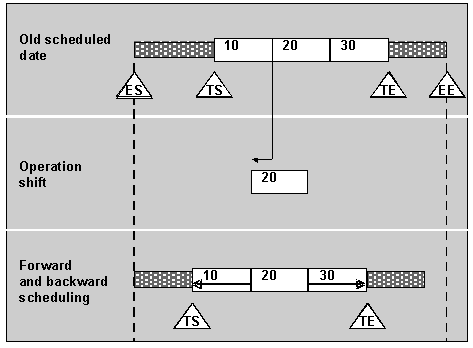
If several operations already have the status dispatched, then operations that are situated between these "fixed" operations are moved during midpoint scheduling in the direction that is set for order scheduling. If they overlap with operations that are already dispatched, then this is displayed in the scheduling log.
If scheduling conflicts arise during midpoint scheduling, then the appropriate system messages are written into the scheduling log. You can call up the log directly from both of the planning tables.
If you activate the function Midpoint scheduling in the strategy profile in Customizing, then the system carries out midpoint scheduling when the status dispatched is set. If the function Midpoint scheduling is not activated in the strategy profile in Customizing, then the system carries out midpoint scheduling for the order when you save the planning table.
You can find more information on lead time scheduling in
Scheduling or in the guides PP - Material requirements planning or PP - Production orders.