
 Requirements Grouping for Individual Project Planning
Use
Requirements grouping is a planning procedure for projects within material requirements planning.
Requirements grouping for individual project planning enables you to group material requirements that are caused by WBS elements within a project or also cross-project, and plan and procure them together. This enables you to save costs.

Requirements grouping is possible only for operative WBS elements.
Prerequisites
You are using the component Project system for the processing of projects.
Integration
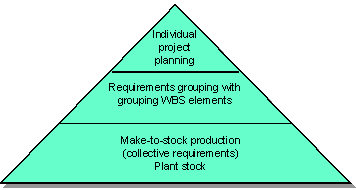
Basically, there are three procedures for planning material requirements in projects in the SAP System:
- Individual project planning
The system only plans individual requirements. Materials that are required for a project (WBS element) are specifically planned for the project and are procured with reference to the WBS element. The materials in the individual project stock of the WBS element are managed and settled separately from the normal stock. Goods issue only takes place with reference to the WBS element.
This procedure is used to plan finished products and important assemblies.
- Requirements grouping for individual project planning using grouping WBS elements
The material requirements for different WBS elements are combined and jointly planned and procured. If you combine the WBS elements within a project to one grouping WBS element, you will have real individual project stock.
If you use cross-project requirements grouping, the ordering parties must give their consent that the assemblies and components are planned and procured using this procedure.
- Planning collective requirements (Make-to-stock production)
You can plan and procure materials at subordinate BOM levels that are required in all projects, independently of WBS elements, using make-to-stock production. During the planning run, the system calculates the total requirements of a material in a plant. The material is procured without reference to a WBS element.
These materials are managed in the plant stock and are available for all projects.
Features
The requirements grouping for the materials of different WBS elements are carried out by using one or more grouping WBS elements.
- If you would like to group requirements of WBS elements within a project, the Automatic Requirements Grouping function is available. With this procedure, all requirements are combined into one grouping WBS element of the project. This has the advantage that you have "real" individual project stock, or project definition stock, for the whole project.
- In cross-project requirements grouping you assign the WBS element to one or more grouping WBS elements. The grouping WBS elements thereby have a grouping function.

You group all WBS elements of projects from the private sector into one grouping WBS element and combine all WBS elements from the public sector into another grouping WBS element and plan each together.
Requirements grouping in individual project planning has the following features:
- It combines several WBS elements into one grouping WBS element for the planning.
- It plans material requirements that have been caused by WBS elements, together on the basis of the grouping WBS element.
- Material requirements planning creates procurement elements (planned orders, purchase requisitions) that are assigned to the account of the grouping WBS element.
- In MRP evaluations, an individual MRP segment is managed for each grouping WBS element.
- You manage individual project stock for each grouping WBS element. All materials that are required by the WBS elements belonging to the grouping WBS element are included in this stock.
- The materials in the project stock of the grouping WBS element are available for every WBS element that is assigned to the grouping WBS element.
- The complete procurement costs are incurred by the grouping WBS element. The costs are posted to the network activity with the withdrawal of the procured material for production. During the procurement phase, no costs are visible for the WBS elements, which have caused the requirements. It is not until the withdrawal, that the procurement costs are assigned to the appropriate WBS element.