
 Model Initialization
Model initialization is the process of determining the necessary model parameters⎯ such as the basic value, the trend value, and the seasonal indices⎯ for the selected forecast model. It is necessary when you use a model that forecasts a value for one period based on the forecast value for the period directly before it. Obviously an initial value is required to start the forecast.
The following table shows you which model parameters are necessary for each forecast model.
|
Model |
Model parameters |
|
Constant model |
Basic value |
|
Trend model |
Basic value, trend value |
|
Seasonal model |
Basic value, seasonal indices |
|
Seasonal trend model |
Basic value, trend value, seasonal indices |
As a general rule, the forecast model is initialized automatically. In order to do this, the system requires a certain number of historical values. This number depends on the forecast model, as shown in the following table.
|
Model |
No. of historical values |
|
Constant model |
1 |
|
Trend model |
3 |
|
Seasonal model |
1 season |
|
Seasonal trend model |
1 season + 3 |
|
2nd-order exp. smoothing |
3 |
|
Moving average |
1 |
|
Weighted moving average |
1 |
In material forecasting you can however specify how many vales are to be used for initialization.
The system calculates the basic value on the basis of the average and the trend using the results of the regression analysis. The seasonal indices are given by the actual historical value divided by the basic value adjusted for the trend value.
These calculation methods are used for the constant, trend, seasonal, and seasonal trend models, depending on which parameters are to be determined.
A regression analysis is carried out for the second-order exponential smoothing model.
For the moving average and weighted moving average models, the system calculates an average value.
The following variables are used in the equations below:
|
Variable |
Meaning |
|
j |
Control variable |
|
i |
Number of entries in period (here usually the initialisation period) |
|
V(j) |
Historical value for period j |
|
PERIO |
Numer of period in a seasonal cycle |
Constant Model
Basic value – G(init)

Mean absolute deviation (MAD) initialization

Trend Model
Trend Value T Initialization
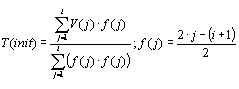
Mean absolute deviation (MAD) initialization

Seasonal Model
Seasonal index S initialization

MAD initialization

Seasonal Trend Model
Trend index initialization
First the trend index is calculated for each season.
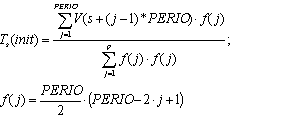
The average is then calculated over the seasons

Seasonal index S initialization
