
 Forecast Models
Use
When a series of consumption values is analyzed, it normally reveals a pattern or patterns. These patterns can then be matched up with one of the forecast models listed below:
- Constant⎯consumption values vary very little from a stable mean value
- Trend⎯consumption values fall or rise constantly over a long period of time with only occasional deviations
- Seasonal⎯periodically recurring peak or low values differ significantly from a stable mean value
- Seasonal trend⎯continual increase or decrease in the mean value
- Copy of actual data (no forecast is executed)⎯copies the historical data updated from the operative application, which you can then edit
- Irregular⎯no pattern can be detected in a series of historical consumption values
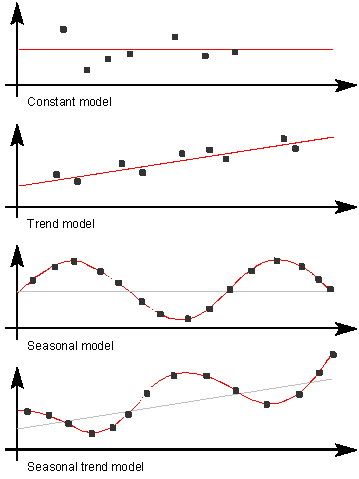
Mathematically speaking, the seasonal trend is the most complex of these models. The forecast value consists of a basic value term G from the constant model, a trend term T from the trend model and a seasonal term S from the seasonal model. For more details see Trend and Seasonal Models with First-Order Exponential Smoothing.